
The order things fail
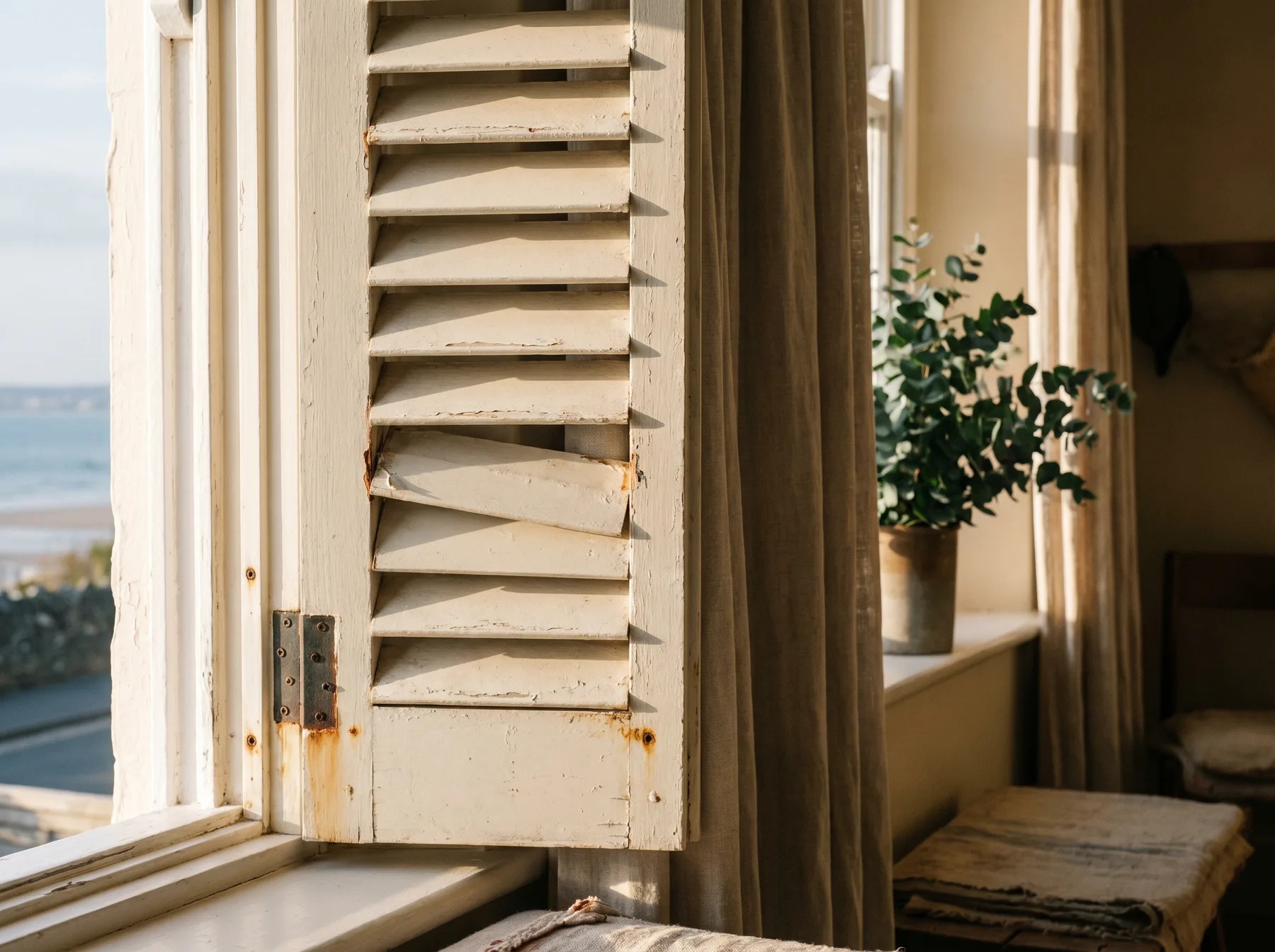
A shutter is a frame, panels, louvres, a tilt mechanism, and hardware. Around this lake the failure sequence is remarkably consistent: fasteners and hinges first (they're the sacrificial metal), tilt mechanisms second (they're metal under motion), finish third (sun and salt working together), and the panels themselves last, often never. Which means a set that feels done is often a set whose hardware is done, and hardware is a repair for whoever fitted it.
The ten-minute self-assessment
- 1. Screw heads
Look for rust bloom, the orange shadow around fastener heads. Cosmetic today, structural in a few years. Caught early it's the cheapest fix on this list.
- 2. Hinges
Swing every panel fully. A creak wants lubrication; a grind or visible corrosion wants replacement; a panel that's dropped on its hinges wants re-hanging. All repairs, none of them a re-fit.
- 3. Tilt under load
Run the louvres full travel. Stiff, slipping, or won't hold an angle: tension and wear, usually serviceable. A snapped connection inside the stile is a bigger job but still usually a repair.
- 4. Louvres in raking light
Sight along the blades late in the day. One or two warped or dropped blades can often be replaced individually; a whole panel of banana blades is the panel telling you its story is ending.
- 5. The finish
Chalking (a powdery white wipe on your fingertip) can sometimes clean back and seal; deep UV yellowing or flaking through to the substrate generally can't, honestly.
- 6. Panel squareness
A panel that won't close flush is usually hinge sag or frame movement, both fixable. A panel that has itself gone out of square, twisted at the corners, is done.
Where the honest line sits
A rule of thumb: when the trouble lives in the metal (hinges, screws, tilt gear) or in one or two blades, a repair may be all it needs, and that's a question for whoever fitted them. When the trouble lives in the panels themselves, warp, structural joints, finish beyond saving, or when parts belong to a system nobody stocks any more, replacement is the honest call, and that's where we come in: a free measure and quote for new shutters.
If you've decided it's time for new ones, the free measure leaves you a written quote, with no obligation.
When it's time for new ones
You book through the form, we measure the same openings, bring samples you can hold up in your own light, and leave you a written quote. For repairs to shutters you already have, ask whoever fitted them, or the maker if the system needs its own parts.
If your shutters pass the self-assessment above with just a creak or two, you may not need us yet at all: the salt-air care checklist is the maintenance rhythm that keeps a passing grade passing.
Your shutter may be luckier or unluckier than the pattern; the self-assessment above is the place to start.