
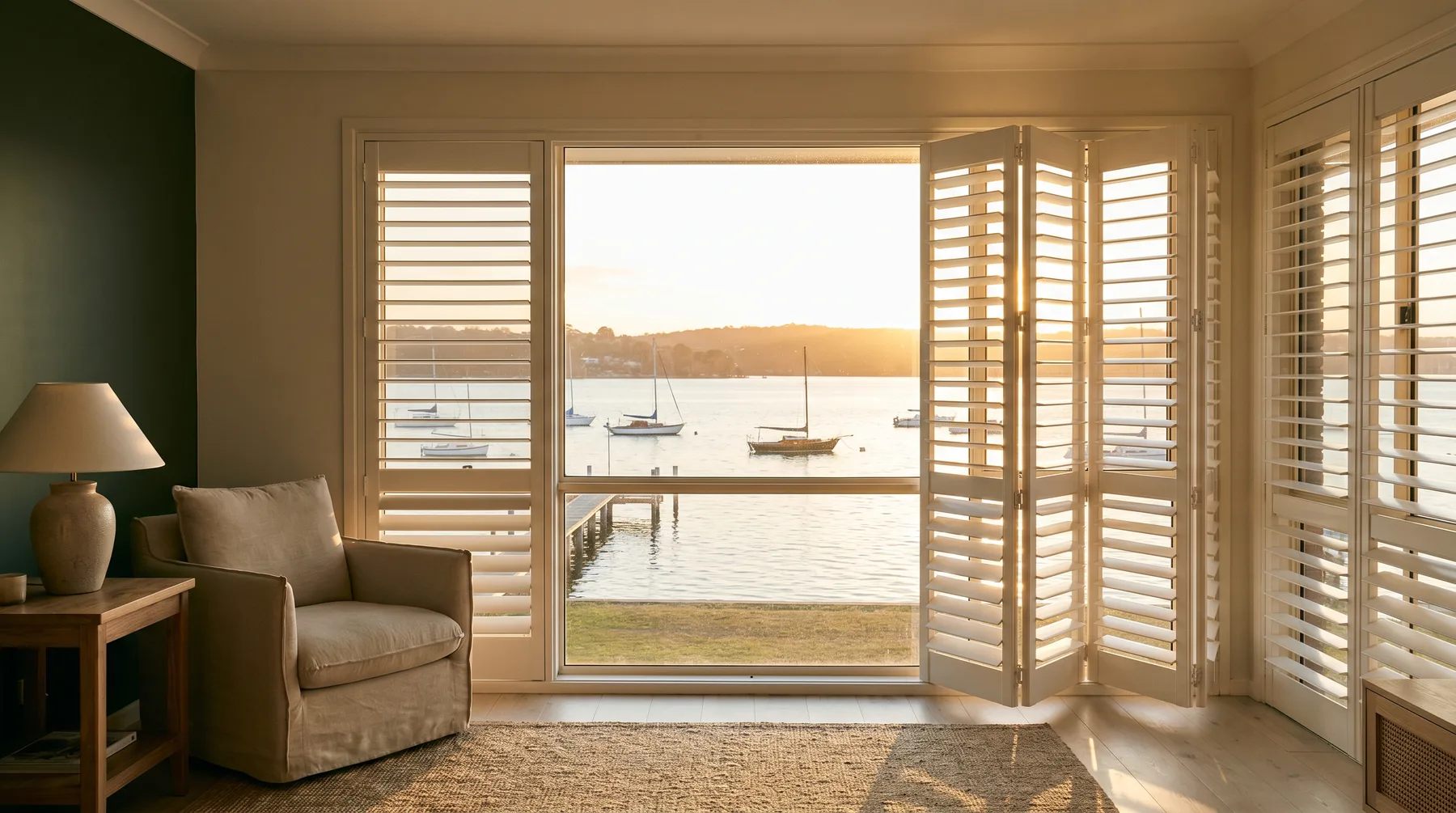
Yes, shutters can help with heat. The federal government's own home design guide lists them as a shading option. The reason it matters is simple: up to 87% of the heat a home gains can come in through its windows and glass doors. This spring, the Bureau of Meteorology says above-average day and night temperatures are very likely across NSW. That makes the windows that catch the most sun the place to start.
Do plantation shutters block out heat?
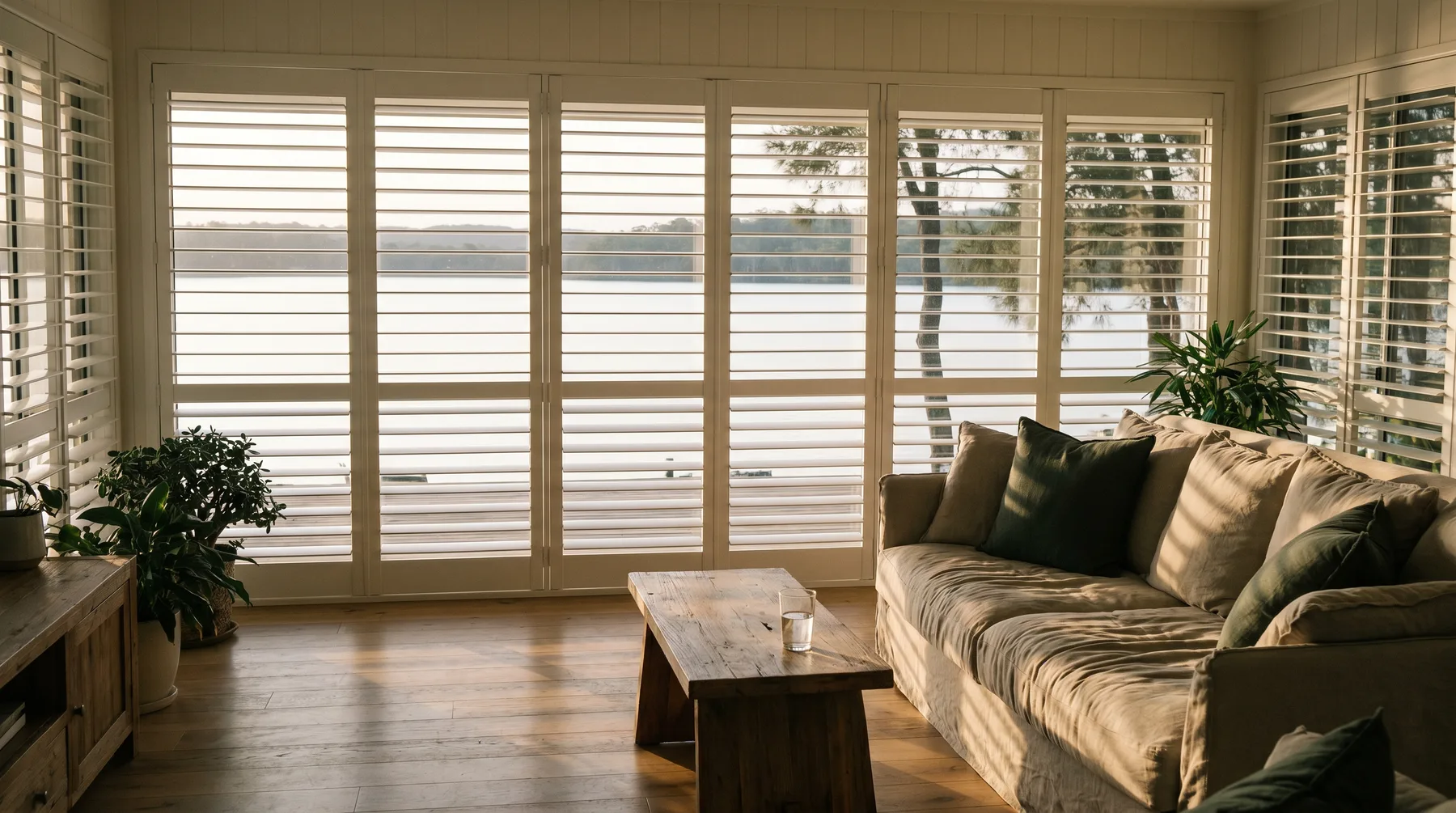
Shutters block direct sun, and YourHome says unprotected glass is often the greatest source of heat entering a home. The Australian Government's YourHome guide names shutters alongside eaves, awnings and plantings as a way to maximise thermal comfort, letting winter sun in while blocking summer rays.
At Lake Macquarie Shutters we'd add one honest caveat. Where a covering sits matters. Shading outside the glass stops the sun before it reaches the window. A covering inside the glass, which is where most plantation shutters go, works on sun that has already come through. It keeps the direct beam off your floors, furniture and people, and it lets you choose how much light you take in.
So the useful question is not "do shutters block heat?" but "which windows need shading, and what kind suits each one?"
Why windows let in more heat than walls
A wall has insulation, mass and cladding between you and the weather. A window has one or two thin layers of glass. YourHome puts the gap in numbers: up to 40% of a home's heating energy can be lost through glazing, and up to 87% of its heat gained.
The second figure is the one for spring and summer. If most of the heat comes in through the glass, the glass is where your effort pays off first. Insulating a wall does little for a room that is baking because the afternoon sun is pouring through a bare sliding door.
Where shutters fit in the official shading advice
YourHome's shading advice is built around one idea: let the low winter sun in and keep the high summer sun out. Fixed shading, such as an eave, does this by geometry. It shades a north window when the sun is high and lets sun under when it is low.
Adjustable louvres do the same job by hand. Tilt them one way and high sun is turned aside while you keep your view. Close them and direct sun stays off the room. Open them flat in winter and the light comes back. The same window can be shaded in January and sunlit in July.
YourHome's shading page lists shutters among the adjustable shading suited to east and west windows, next to sliding screens, louvre screens, retractable awnings and adjustable external blinds. Plantation shutters inside the glass are one option among several, and on some windows an eave or awning outside will do more. On the windows eaves can't reach, a covering you can adjust is often the practical answer.
Which windows to shade first
The sun's path decides this for you. In Australia it rises in the east, swings through the north and sets in the west.
North windows get the high midday sun in summer. A well-sized eave handles much of it, which is the textbook passive design case.
East windows get morning sun. It is lower and cooler than afternoon sun, but it can still heat a bedroom or kitchen early in the day.
West windows are the hard ones. The late afternoon sun is low, so it slides straight under eaves. It also arrives when the house has already been warming all day.
Lake Macquarie adds its own twist. A home with its view facing west across the water can get the afternoon sun twice: once directly, and again as glare off the lake. Big glass doors that open to that view are often the hottest, brightest openings in the house. Our guide to west window glare covers the blade widths and tilt angles that deal with it.
If you only do one thing this spring, stand in your west-facing rooms late on a sunny afternoon. The rooms you want to walk out of are your first shading job.
Why this spring is worth planning for
Above-average daytime and overnight temperatures are very likely across NSW this spring.
The Bureau of Meteorology's long-range forecast, issued 27 August 2026 for September to November, says above-average daytime and overnight temperatures are very likely across NSW and the ACT.
Warmer nights matter as much as warmer days. A house that soaks up heat through its west glass all afternoon has more heat to shed after dark. Shading the glass during the day is one of the few things that works on both problems at once.
A forecast is a set of odds, not a promise, and nobody can say how your particular house will feel. But the direction is clear enough to act on before summer rather than during it.
UV doesn't wait for summer
Heat is the obvious reason to shade a window. UV is the one people forget. Cancer Institute NSW says UV levels in NSW are high, at UV index 3 or above, from August until May. That includes cool and cloudy spring days. Cancer Council Australia recommends sun protection whenever the UV index is forecast to reach 3 or above, and the Bureau of Meteorology issues sun protection times whenever the index is forecast to reach that level.
What about UV indoors? The closest official figure we found is for cars. ARPANSA says the amount of UVB through the plain window glass used in car side windows varies widely, but that most types transmit about 60% of the UVA. Your house glass may differ, so treat it as a reminder rather than a measurement: glass is not a complete UV barrier, and a sunny spot by a window is still a sunny spot.
Questions to ask before you choose any window covering
Start with your own house, then take your notes to whoever you talk to about coverings.
Walk your house and note:
Ask any installer:
A good answer to the first question tells you a lot. It sets what the covering can realistically do about heat, and it is the question least often asked.
Your next step
Do the afternoon walk-through while the spring sun is still gentle enough to stand in. Once you know which windows are the problem, talk to Lake Macquarie Shutters about them. You can read more about shutters for Lake Macquarie homes or book a free measure and quote. The west-facing rooms and bare glass doors are the obvious place to start.
Sources
- Bureau of Meteorology, long-range forecast for spring 2026: https://www.bom.gov.au/news-and-media/the-bureau-issues-long-range-forecast-for-spring
- YourHome, Australian Government, Passive design: https://www.yourhome.gov.au/passive-design
- YourHome, Australian Government, Shading: https://www.yourhome.gov.au/passive-design/shading
- Cancer Institute NSW, Know the UV index: https://www.cancer.nsw.gov.au/prevention-and-screening/preventing-cancer/preventing-skin-cancer/reduce-your-skin-cancer-risk/know-the-uv-index
- Cancer Council Australia, UV Index: https://www.cancer.org.au/cancer-information/causes-and-prevention/sun-safety/uv-index
- ARPANSA, Sun exposure frequently asked questions: https://www.arpansa.gov.au/understanding-radiation/radiation-sources/more-radiation-sources/sun-exposure/frequently-asked-questions
Pictures in this guide are illustrations, not photos of our jobs.