
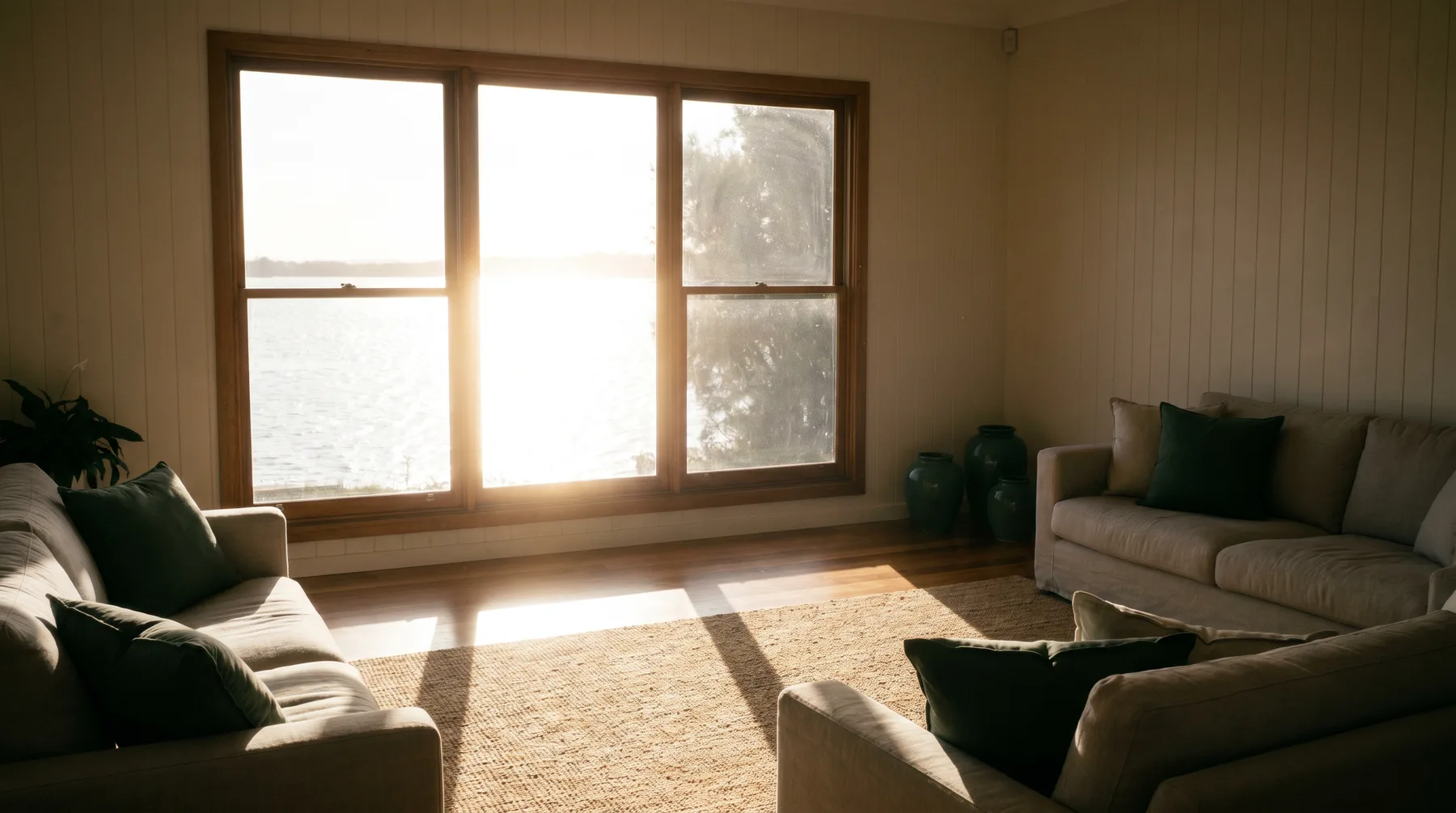
The sun arrives twice
Everywhere in Australia, a west window cops the afternoon sun. On this lake, it cops it twice: once direct from the sky, and once bounced off the water. The lake's surface behaves like a forty-kilometre mirror laid flat, and as the sun drops toward Toronto, the reflection climbs. Between about three and six on a summer afternoon, the glare band off the water walks up your wall, across the television, and into your eyes.
That second, reflected sun is why treatments that work fine inland disappoint here. A tinted film or a deep eave handles light from above; neither does much about light arriving from below the horizon line, which is exactly where the water bounce comes from. Whatever you fit has to manage two arrival angles at once, and be adjustable, because those angles move by the hour and by the season.
Why heat is part of the same problem
Glare is what you notice; heat is what you pay for. Glass is the weakest point in a home's defence against summer heat: the Australian Government's YourHome guide to shading puts direct sun through unprotected glass among the largest contributors to summer heat gain in a house, which matches what any lakeside owner can feel standing at their own west window in January. A big view window over water is that problem at its maximum: maximum glass, maximum exposure, maximum reflection.
An adjustable louvre stack works on both fronts. Closed, it's an insulating layer over the glass. Half-tilted, it shades the room while the breeze and the view keep moving. And unlike a fixed treatment, it does the right thing in winter too, opening right up when that same low western sun becomes the free heating you actually want.
The two-angle fix, drawn
Tilt: the hand on the rod
Because the reflected glare arrives travelling slightly upward, a louvre tilted a few degrees down toward the water intercepts it while leaving the upper sky path open. That's the whole craft in one sentence, and it's why a shutter beats a fixed screen here: the right angle at 4pm in January is not the right angle at 10am in July, and the rod puts the choice in your hand.
- Morning and midday: blades near flat, the room fully open to the view, the water still a picture rather than a floodlight.
- Mid afternoon: ten to twenty degrees down. Glare band intercepted, horizon still visible in the gaps, room stays bright.
- The last brutal hour: steeper, or closed on the worst panels only. A shutter is panels, not a single sheet; close two, leave three open.
If you want to feel this rather than read it, the tilt planner on our home page is this guide as a toy: drag the blades, watch the glare band and the horizon trade places.
Blade width: how much view survives
Tilt manages the light; blade width decides how much horizon you keep while it does. A louvre stack interrupts the view with one bar per blade, so fewer, wider blades mean fewer interruptions and bigger clear bands when open. On a west view window we recommend 89mm as the floor and 114mm where the glass is big enough to carry it. The full arithmetic, with the sight-line diagrams, lives in the blade-width note.
What we'd fit, room by room
| Room | Starting spec | The reasoning |
|---|---|---|
| Living room on the water | 114mm, hidden tilt, aluminium or PVC | Maximum view, clean sight lines, salt-proof hardware. |
| West bedroom | 89mm, hidden tilt, plus a blockout layer | Tilt for the evening; the blockout does the summer sunrise. |
| Kitchen with a west splash of glass | 89mm PVC | Wipe-down material where cooking steam meets lake air. |
| The worst window in the house | Shutter inside, awning outside | Stop the heat before the glass, manage the glare behind it. The awnings page explains. |
What doesn't work (asked and answered)
- Dark tint alone: dims the room all day to fix one bad hour, and does nothing for the heat load radiating off hot glass.
- Curtains alone: fix the glare by deleting the view, which is the one trade nobody on the waterfront wants. As a soft layer with shutters, they're excellent.
- Toughing it out: the floor fades in a stripe, the telly is unwatchable at six, and the room quietly stops being used in summer. We've measured a lot of lounges that migrated to the other end of the house.
Written from what we see at measures around the lake. When something here doesn't match your window, trust your window, then book the measure and we'll look at it together.
Reference
- YourHome: Shading, the Australian Government's design guide. The plain-English authority on how much heat unshaded glass lets into a home, and why adjustable shading beats fixed in mixed climates.