
The arithmetic, in one paragraph
Louvres stack at roughly their own width: a metre-and-a-half of window carries around twenty-three blades at 63mm, sixteen at 89mm, or thirteen at 114mm. Every blade is a bar across the view, so the wide blade puts nearly half as many interruptions in front of the water as the narrow one. Open the louvres and the same logic pays again: the clear gap between blades scales with the width, so a 114mm stack tilted flat gives you bands of view nearly twice as tall as a 63mm stack does.
So why not always go widest?
Because width has costs as well as views, and pretending otherwise is how brochures talk. The honest trade-offs:
- Window size
Wide blades on a small window look like venetian slats on a dollhouse: three blades and a rail is a proportion nobody wants. Small openings genuinely suit 63mm.
- Privacy response
A wide blade travels further between open and closed, so fine privacy adjustments are slightly coarser. Street-facing rooms that live half-closed often prefer 89mm.
- Projection
Open a 114mm louvre and it stands proud of the frame plane; tight reveals, walkways past the window and some furniture placements need that checked at the measure.
- The room's era
Wide reads modern. In a classic brick lounge, 89mm with a front tilt rod often sits more truly with the house than a panoramic 114mm stack.
Where the horizon falls
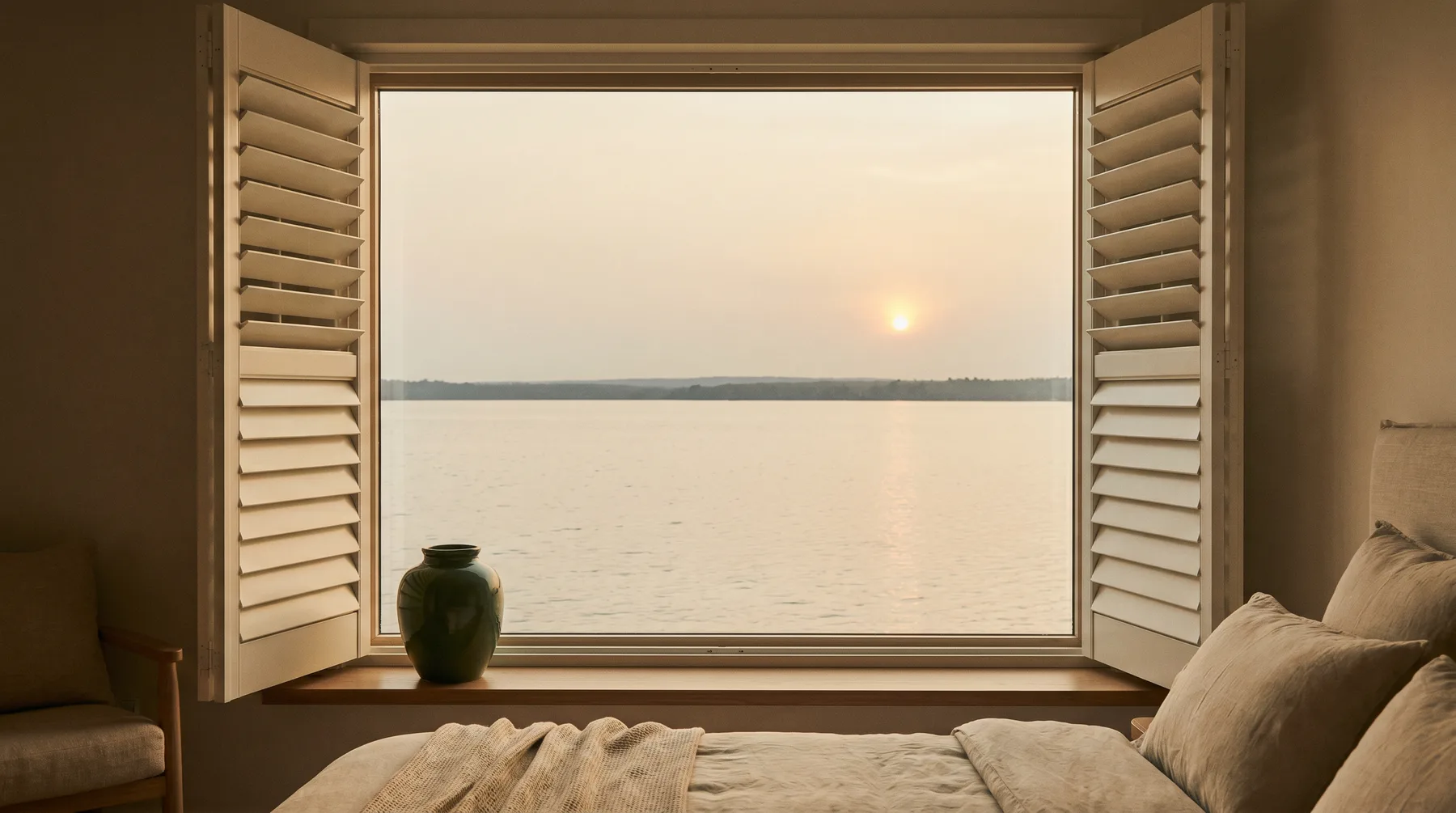
One subtlety the brochures never mention: what matters on a view window isn't just how many bars, but where they fall. If a blade edge sits exactly at the water line, the view's best feature lives in its shadow at half the tilt range. At the measure we note your seated eye height and where the horizon crosses the glass, and set the stack so the water line falls in a gap, not on a blade. It's a small thing that costs nothing and changes the room, and it's the kind of thing a made-to-measure panel can do that a stock one can't.
You can feel this trade live in the tilt planner: switch widths and watch whether the horizon sits in the clear.
Our defaults, for what they're worth
- View windows over water: 114mm where the glass carries it, 89mm otherwise. Hidden tilt, so the sight line stays clean.
- Most living areas: 89mm, the width that's almost never wrong.
- Wet rooms, small openings, privacy-first windows: 63mm or 89mm, with PVC where there's steam.
Defaults are where the conversation starts, not where it ends. Bring your window's worst hour to the free measure and we'll set the width against the real light.