
Plantation shutters are a comfort and privacy product, not a bushfire measure. The window guidance from the NSW RFS and CSIRO deals with three things fitted to the window itself: glass, fine metal mesh and non-combustible protective shutters. Interior plantation shutters are not a substitute for any of them.
So the first job is not a product at all. It is checking the current map. Lake Macquarie's new map changed the status of about 5,300 properties. That is our estimate, adding council's two figures: about 800 properties are newly considered bush fire prone and about 4500 are no longer at risk. If you checked your status a few years ago, that answer may be out of date.
Do plantation shutters help in a bushfire?
"No single protection measure alone will provide sufficient protection from a bush fire"
The RFS is blunt about single fixes: "No single protection measure alone will provide sufficient protection from a bush fire". For windows, it points to "glass that's thick enough to protect against the heat of a fire, and metallic screening" to keep embers out.
CSIRO's guidance for new builds also mentions shutters. It says to consider installing non-combustible shutters to protect against flame contact, embers, and strikes from flying objects. Those are protective systems on the window. They are a different thing from louvred shutters in a lounge room.
At Lake Macquarie Shutters we would rather say this plainly than leave you guessing. Interior plantation shutters are about light, privacy and comfort. On bush fire prone land, they sit on top of the right glass and screens, never in place of them.
Is your home on the current bush fire prone map?
Lake Macquarie's new Bush Fire Prone Land Map
Bush fire prone land maps are prepared by councils and certified by the NSW RFS Commissioner. You can check your status in three ways: with council, on your Section 10.7 planning certificate, or with the RFS map tool. Lake Macquarie City Council also points residents to its online property information service and the RFS site.
A home's status can change, so check the current map rather than relying on what you remember.
Council's release also names three higher-risk focus areas to 2029: Seahampton to Wakefield, Whitebridge to Redhead, and Cooranbong to Martinsville. Those names describe focus areas, not individual homes. Only the map can tell you where a particular property sits.
Being off the map is not the same as being safe. The RFS says a property's status "does not mean that your property is not at risk from bush fire attack".
If your home is on the map, the next question is its Bushfire Attack Level, or BAL.
How CSIRO matches window protection to each Bushfire Attack Level
- BAL-12.5: annealed (standard) glass
- BAL-29: toughened glass
- BAL-40: fire-rated glass
- BAL-FZ (Flame Zone): non-combustible frame with non-combustible shutter
In Lake Macquarie, building work on bush fire prone land must consider AS 3959 and the RFS's Planning for Bush Fire Protection. Council lists six BALs: BAL-LOW, 12.5, 19, 29, 40 and FZ.
CSIRO's table of window exposure protection by BAL climbs in four steps:
- annealed (standard) glass at BAL-12.5
- toughened glass at BAL-29
- fire-rated glass at BAL-40
- a non-combustible frame with a non-combustible shutter at BAL-FZ, the Flame Zone
Look at what the ladder is made of: glass, frames and non-combustible shutters on the window. Window coverings do not appear on any step.
Your property's BAL comes from an assessment, not from a chart. Council, the RFS or a bush fire consultant can tell you where your home sits.
Embers are the main threat at a window
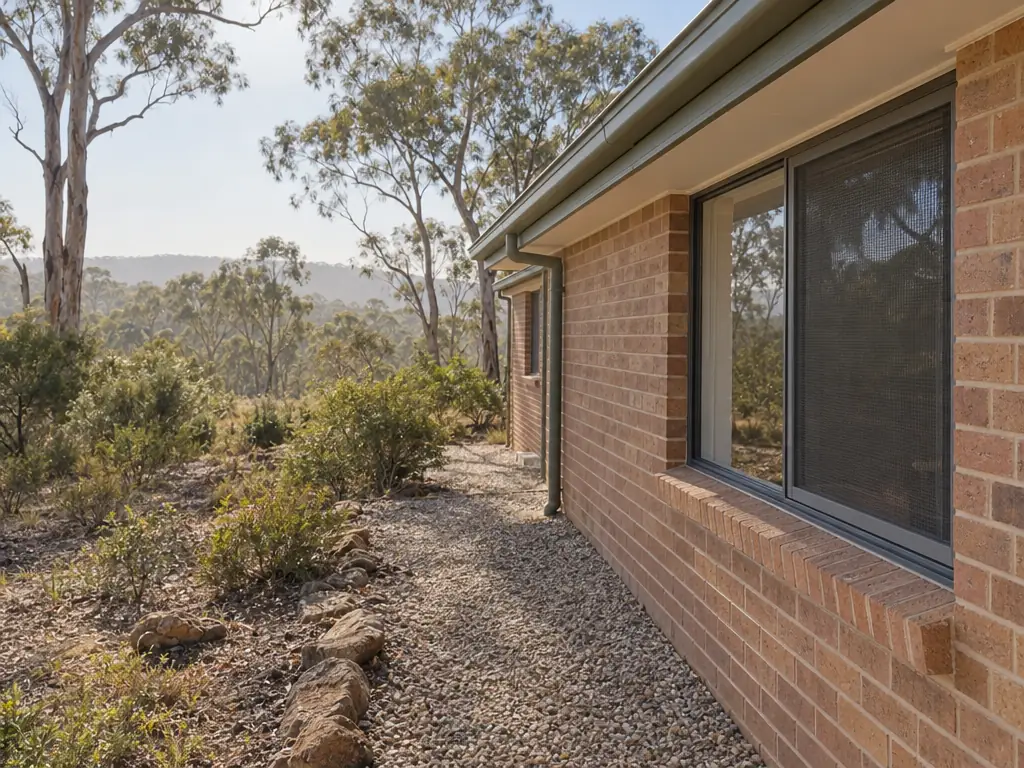
The RFS figure that should shape your planning is this: 85% of houses are lost from ember attack. Embers can travel over distances greater than 100 metres from the fire front. Once they land, gaps, cracks and places where embers and debris can lodge reduce a building's resistance.
At the window itself, the guidance comes down to a few concrete jobs:
- For ember attack, CSIRO says openable windows should have metal mesh with apertures under 2 mm.
- When a fire threatens, close all windows and doors, because openings let in smoke, flames, embers and radiant heat.
- CSIRO also says windows and doors should be easy to open from inside without a key. That is worth remembering for anything you fit over a window.
- Outside, the RFS says to avoid placing garden beds under windows and to keep trees away from them.
For an existing home, the RFS says upgrading is "not mandatory", but it strongly recommends it.
Ember-ready windows
Upgrading an existing home is not mandatory in NSW, but the RFS strongly recommends it.
Radiant heat passes through window glass
The RFS says "glazing is one element of a building that is highly susceptible to the impacts of radiant heat and flying debris". It goes further: "a large proportion of radiant heat can pass through a window and heat internal furnishings such as carpets, curtains or furniture".
That is one reason the BAL steps are about the glass: CSIRO notes glazing can break from radiant heat, high wind loads and direct flame contact.
Everyday summer sun is a separate question, and a much gentler one. Our guide Do Plantation Shutters Block Out Heat? covers it.
Changing windows on bush fire prone land? Check before you start
Do my window works need a bush fire check?
On bush fire prone land, alterations or additions to existing dwellings go through the same process as new buildings. The work and the existing dwelling "may require ember protection".
Two points from the RFS help here:
- The RFS itself charges no fee for DAs for alterations or additions to existing dwellings (checked November 2026).
- You can call the RFS on 1300 679 737.
Council adds that complying development is not allowed on BAL-40 or BAL-FZ land.
Then there is the condition many owners forget. If your home's development consent required a certain bush fire construction level, council says you must maintain it. Failing to do so could cause your home insurance to be invalid.
Before you swap windows, add a room or change anything on the outside of the glass, ring council or the RFS first. If you are only choosing interior coverings and are unsure whether any part of the job counts as an alteration, ask as well. It costs a phone call.
How long this fire season runs
The statutory Bush Fire Danger Period runs 1 October to 31 March, "however it may vary due to local conditions". Lake Macquarie is listed as a council where a fire permit is required.
The season ahead looks hot. The Bureau of Meteorology's 29 October outlook says November to January daytime and overnight temperatures are very likely (more than 80% chance) to be above average across almost all of Australia. It also says a strong El Niño is underway and likely to peak around November to December. The Bureau adds that this "does not necessarily mean strong impacts on Australia's rainfall and temperature".
AFAC's spring outlook predicts "a heightened risk of fire across northern and southeastern New South Wales". It also reminds us that "bushfires can still occur in regions with a normal seasonal outlook".
A plan matters more than any product. The RFS says a well prepared home is more likely to survive a bush fire, and its plan-and-prepare pages are the place to start.
If the house will sit empty over the holidays, our guide on empty holiday homes covers what to lock up and leave covered. For the warm nights in between, see keeping a bedroom cool at night.
Your fire-season order of jobs, with coverings last
- Check the current bush fire prone map, even if you have checked before.
- If you are on it, find out your BAL, and whether your consent set a construction level you must keep.
- Sort the window jobs the guidance names: suitable glass for your BAL, ember mesh under 2 mm on openable windows, gaps fixed, and garden beds moved out from under the windows.
- Ring council or the RFS before any alteration or addition.
- Then choose your coverings for light, privacy and comfort.
When you reach step five, book a measure and quote with Lake Macquarie Shutters on our Book a Free Measure & Quote page. Tell us your home is on or near bush fire prone land, and we will talk through the windows with that in mind.
Sources
- Fire permits, NSW Rural Fire Service
- Building on bush fire prone land: what you need to know, NSW Rural Fire Service
- Building after bush fire: FAQs, NSW Rural Fire Service
- Plan and prepare, NSW Rural Fire Service
- Council zeros in on bushfire risk areas, Lake Macquarie City Council
- Development in bush fire prone areas, Lake Macquarie City Council
- Windows and doors, CSIRO Bushfire Research
- Climate outlook, 29 October 2026, Bureau of Meteorology
- Seasonal Bushfire Outlook Spring 2026, AFAC