
Two Bureau of Meteorology outlooks, issued a fortnight apart, both put the chance of unusually warm nights at over 80% for much of Australia, and November and December fall inside both of them. The outlook issued 1 October covers October to December and gives an "exceptionally high (over 80% chance)" of unusually high minimum temperatures for much of the country. The outlook issued 15 October covers November to January and gives a "very high (over 80% chance)". Put the two windows side by side and they overlap on November and December. Those are the months BOM says El Niño is likely to peak around November to December as a very strong event.
These are odds, not a forecast for any single night. They still point to the nights most likely to test your sleep being the ones right in front of us. The part you control starts hours before bed, with how much heat the bedroom takes in through its glass during the day.
What "unusually warm nights" means in BOM's outlook
A likelihood, not a forecast for any single night.
BOM defines unusually high minimums as those in the warmest 20% of November to January nights between 1981 and 2018. In a normal year, then, the odds of landing in that band are 20%. An over-80% chance is, in the 1 October outlook's own words, more than 4 times the normal likelihood.
Usual odds: 20% (unusually high minimums are the warmest 20% of November to January nights, 1981 to 2018)
more than 4 times the normal likelihood (BOM, 1 Oct 2026 outlook)
Outlook odds: over 80% for much of the country
A likelihood, not a guarantee for any night.
Days look warm too. The 1 October outlook (October to December) puts the chance of unusually high maximums at over 80% across most of New South Wales, Victoria and Tasmania; the 15 October outlook (November to January) puts the highest chances at over 70% across parts of those states. The season starts from a hot base: globally, September 2026 was the warmest September on record, and BOM's ENSO update issued 27 October recorded the weekly relative Niño3.4 index at a record +2.88 °C for the week ending 25 October 2026.
BOM adds its own caution, which is worth keeping in mind. A strong El Niño "does not necessarily mean strong impacts on Australia's rainfall and temperature". The outlook is the guide, not the El Niño label.
Why bedroom windows matter most on a warm night
- Unprotected glass is often the greatest source of heat entering a home
- Up to 87% of a home's heat gained comes through windows
- Insulated but unshaded: built-up heat kept inside, an 'oven' effect
- Effective shading can block up to 90% of the heat
A bedroom that feels stuffy at 11pm is usually still giving off heat it took in at 11am. Your Home, the federal government's home design guide, says unprotected glass is often the greatest source of heat entering a home. Its glazing page puts the figure at up to 87% of a home's heat gained coming through windows.
"Direct sun can generate the same heat as a single bar radiator over each square metre of a surface, but effective shading can block up to 90% of this heat."
Bedrooms facing east get caught out. Their sun arrives early, so they can feel fine at lunchtime. Your Home says east glass starts a cumulative process that causes thermal discomfort in the afternoon and early evening, and that is the evening you are trying to sleep through. West bedrooms take the late sun straight on. Our guides to west window glare and west-facing windows in daylight saving cover that side in detail.
Insulation alone does not keep a house cool: Your Home warns that when a house is not properly shaded in summer, built-up heat can be kept inside by the insulation, creating an 'oven' effect.
Upstairs bedrooms carry two extra risks. Your Home advises you to avoid or limit thermal mass in upstairs sleeping areas, because badly placed mass heats up and radiates heat well into the night. A skylight or other roof glazing gets almost twice the heat of an unprotected west window.
Keep your bedroom cool at night by starting in the morning
A bedroom's 24 hours
- Morning: East sun on the glass starts heat that builds into the afternoon and early evening: coverings closed
- Day: Hot forecast: keep coverings closed all day
- Afternoon: West sun: adjustable external shading is the optimum for east and west glass
- Sunset: Open coverings to let the evening breeze through. Running air conditioning? Keep windows closed (evaporative coolers are the exception)
- Bedtime: Cool shower; go to bed when you feel sleepy; ideal room around 17 to 19 °C
- 3 to 5am: Core body temperature at its lowest: keep a light cover handy
The government's energy advice gives a simple rhythm: "In warmer months, close the coverings during the day to keep your home cool. When the sun sets, open coverings to let the evening breeze blow through your home." The Sleep Health Foundation makes the same point from the sleep side. It suggests heavy drapes or blinds on the windows, kept closed all day when it's forecast to be hot.
How a covering is made matters as much as when it is closed. The government's advice is coverings that reach the floor and are lined with a light-coloured 'block out' backing. Gaps around windows and doors cause draughts, so check the edges as well as the fabric.
For east and west glass, Your Home calls adjustable vertical shading, such as external blinds, the optimum solution (see our awnings page for outside options). Inside the window, louvres, blinds and curtains are especially useful to add to existing windows. Keeping the sun off the glass in the first place will have a much larger effect than choosing better glazing.
Window film is another option. Some films can halve the overall SHGC, the measure of how much solar heat a window lets in, but they may cut daylight. Film on glass in direct sun also risks thermal cracking, so it is generally best to use an accredited installer. Our guide on whether window glass blocks UV weighs film against coverings.
Our view at Lake Macquarie Shutters is that this routine starts with a five-minute walk around the house on a hot afternoon. Put your hand near each bedroom window. The ones with sun on the glass are where the night's heat is coming from.
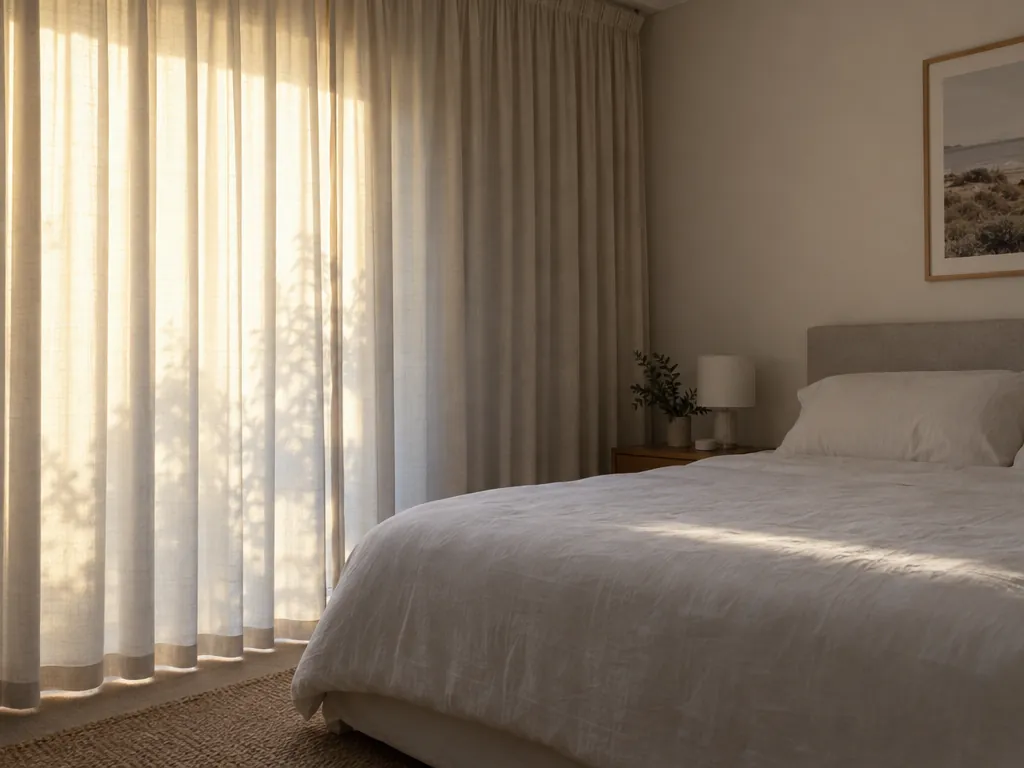
Windows open or closed at night? Decide room by room
| Situation | What the guidance says | Source |
|---|---|---|
| No air conditioning, night air cooler than the room | An open window helps circulate air as it cools overnight, but make sure it doesn't let in mosquitos or flies | Sleep Health Foundation |
| Air conditioner running | Cool the room with the windows closed, unless using an evaporative air cooler | energy.gov.au |
| Evaporative cooler running | The exception to the closed-window rule | energy.gov.au |
| Warm, still night with little drop from the day | Cool night air is a reliable source of cooling inland, where the day to night range usually exceeds 6 to 8 °C. On a humid coast the drop is often smaller. | Your Home (inland figure); coastal point is our reading |
| Storm overnight | Keep people indoors, away from windows | NSW SES |
The official advice pulls two ways, and both sides have a point. The Sleep Health Foundation says an open window helps circulate air as it cools overnight, "but make sure that it doesn't result in an army of mosquitos or flies". The energy guidance says: "Always heat or cool a room with the windows closed, unless using an evaporative air cooler."
Both can be right, because they describe different rooms. If the air conditioner is running, keep that room shut. If it isn't, and the air outside has cooled, an open window behind a sound flyscreen moves air through the room. Your Home calls air movement the key to most sources of passive cooling. Your Home says cool night air is a reliable source of cooling in inland areas where diurnal temperature ranges usually exceed 6 to 8 °C. A humid coast often has a smaller drop, so on a still, warm night the fan does more work than the window.
Storms change the decision too. Storm Season runs September to April, and during a storm the SES advises keeping people indoors away from windows.
Adjustable louvres give you a middle setting. Tilted, they can let air through while angling direct light away. How much difference that makes depends on the window, the breeze and the room, so judge it by how the room feels rather than by a promised figure. Locking up is a separate question, covered in our guide to holiday-home security.
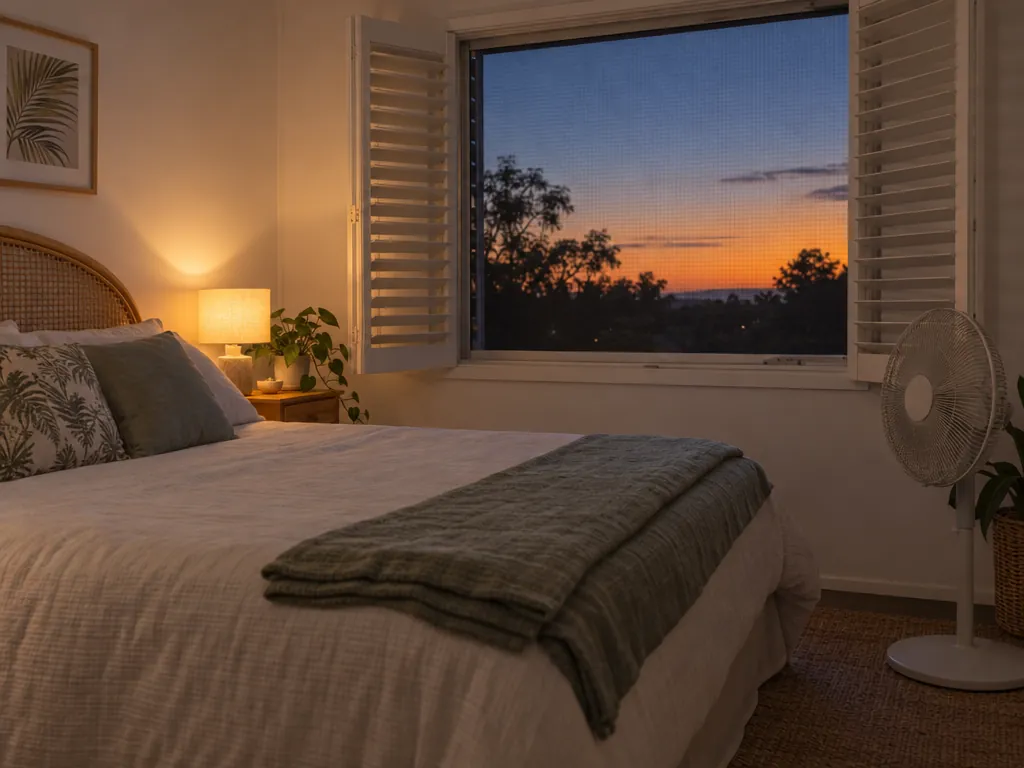
How to sleep in hot weather: the Sleep Health Foundation's list
Tonight's hot-night checklist
The target is cooler than most bedrooms reach in a warm spell. The Sleep Health Foundation says the ideal sleeping temperature is around 17 to 19 degrees Celsius. Where that isn't possible, it helps to have air flowing over your skin, and "even a small, cheap fan can make a difference".
The rest of its list is practical:
- It takes longer to fall asleep when you're hot, so don't go to bed until you feel sleepy.
- A cool shower before bed helps, and cotton sheets are best.
- Core body temperature bottoms out around 3 to 5am, so keep a light cover within reach even on a warm night.
- Air conditioning or evaporative cooling works, but the Foundation calls it a more expensive solution.
None of this replaces the daytime work. A fan moves air around a room. It cannot undo a day of sun on the glass.
The warm-night numbers in one place
- Over 80%: chance of unusually high minimums, November to January, much of AustraliaBOM 15 Oct 2026 outlook
- More than 4 times the normal likelihood: unusually high minimums, October to DecemberBOM 1 Oct 2026 outlook
- 17 to 19 °C: ideal sleeping temperatureSleep Health Foundation
- Around 3 to 5am: core body temperature low pointSleep Health Foundation
- Up to 87%: share of a home's heat gained through windowsYour Home, Glazing
- Up to 90%: heat effective shading can blockYour Home, Shading
Six figures sum up the season: the odds BOM gives, the temperature to aim for, the hour your body runs coolest, and how much of the heat comes through, and can be stopped at, the window.
Talk to us about the bedroom windows that take the sun
Start with the walk-around. Note which bedrooms have sun on the glass in the morning and which get it late in the day, and whether each window has a covering that reaches the floor and closes without gaps. That list is the brief for your bedroom.
If you'd like Lake Macquarie Shutters to look at those windows with you, book a measure and quote. You can also compare the options first on our plantation shutters, blinds and curtains pages.
Sources
- https://www.bom.gov.au/climate/ahead/outlooks/archive/20261001-outlook.shtml
- https://www.bom.gov.au/climate/ahead/outlooks/archive/20261015-outlook.shtml
- https://www.bom.gov.au/climate/enso/index.shtml
- https://www.sleephealthfoundation.org.au/sleep-topics/hot-nights-how-to-help-sleep
- https://www.energy.gov.au/households/windows
- https://www.yourhome.gov.au/passive-design/shading
- https://www.yourhome.gov.au/passive-design/passive-cooling
- https://www.yourhome.gov.au/passive-design/glazing
- https://www.ses.nsw.gov.au/stormseason