

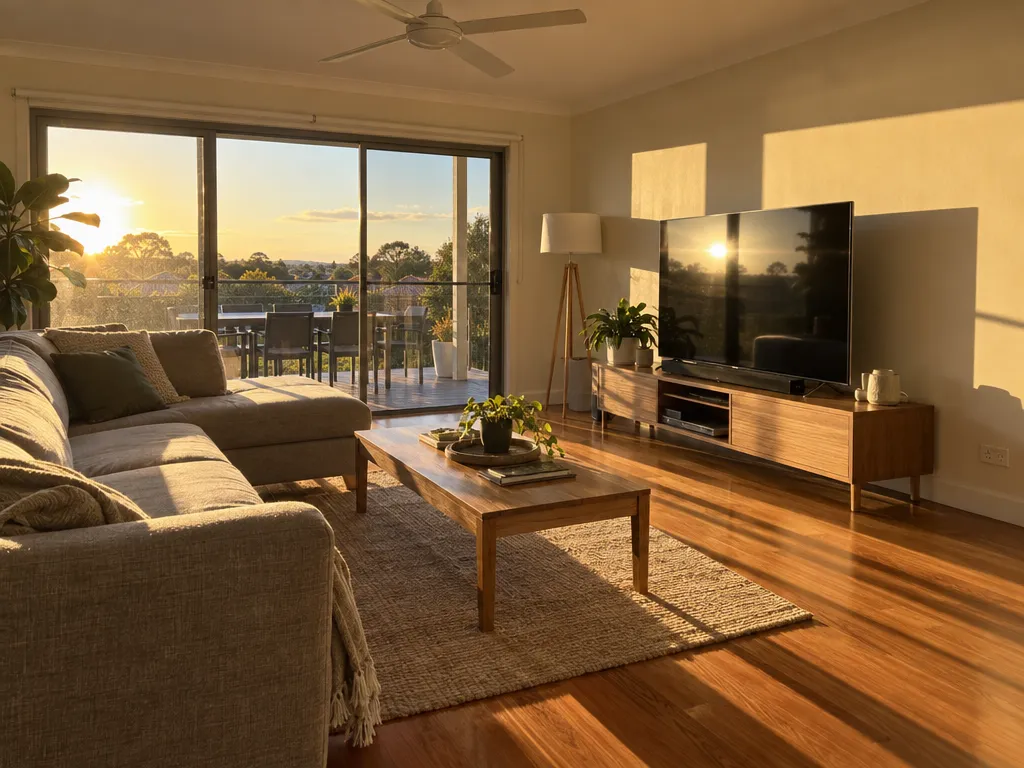
Until April, the hardest sun your house gets will arrive while you're home to feel it. Daylight saving started Sunday 4 October 2026 and ends Sunday 4 April 2027, which is 182 days, or exactly 26 weeks. The sun itself hasn't changed. The clock has. So the low western sun, which meets west glass almost head-on, now lands deeper into the evening, when the family is in the living room.
The fix that does the most is shading the glass itself, ideally with something you can adjust as the sun drops. The Australian Government's home design guide calls adjustable vertical shading, such as external blinds, the optimum solution for east and west windows. Our view at Lake Macquarie Shutters is that most homes end up layering more than one thing, because no single product suits every wall.
Why daylight saving makes west-facing rooms feel worse
Moving the clocks forward does not change the sun's path: the sun reaches the same point over your west window as before, and the clock simply reads an hour later.
The NSW Government moved clocks forward at 2am AEST to 3am, "giving you more daylight in the evening". The point of the change is to use daylight better in the warmer months and cut the need for evening lighting.
That extra evening daylight is welcome on the deck. Through a west window, it means the low, head-on sun now arrives an hour later by the clock, after work and around dinner. It is the same sun, landing at a worse time.
Why afternoon sun on west-facing windows is so hard to block
- High summer sun meets north glass at a steep angle, so it can transmit less heat than west glass
- Summer afternoon: angle of incidence near 0° to 30°, close to the maximum possible solar gain
- Deep verandas and pergolas may still admit very low-angle summer sun
Your Home says low-angle morning and afternoon summer sun on east and west faces is more difficult to shade than north sun. Its glazing page explains why.
On a summer afternoon, sun meets a west window at an angle of incidence from near 0° up to 30°, which is close to the maximum possible solar gain. Zero degrees means the sun is shining straight at the glass.
Now compare north glass. Your Home gives the summer solstice noon sun angle as equinox (90° minus latitude) plus 23.5°, and gives Sydney's latitude as 33.86°S. Worked through, 90 − 33.86 + 23.5 puts the noon sun about 80° above the horizon on the longest day. That figure is our estimate, using Sydney's latitude as the guide gives it.
Sun that high strikes upright north glass at a very steep angle. That's why a north-facing window in summer can transmit less heat than a west-facing one.
It also explains why the usual answer for north windows, an eave, falls short in the west. Deep verandas and pergolas on the east and west may still admit very low-angle summer sun. The sun simply comes in underneath.
Glare and heat are different problems
Unshaded
- Direct sun: about the heat of a single bar radiator per square metre
- Re-radiated heat cannot pass back out through the glass as easily
Shaded outside the glass
- Effective shading can block up to 90% of that heat
Heat: radiant energy trapped indoors
Glare: low, bright sun in your eyes. Too-dark glass makes the room gloomy and the lights go on.
Heat is energy coming through the glass. Direct sun can deliver about the heat of a single bar radiator per square metre, and effective shading can block up to 90% of that. Once inside, radiant heat is absorbed by floors and furniture, then re-radiates at a longer wavelength that "cannot pass back out through the glass as easily".
That's why Your Home calls west-facing glass and walls a significant source of heat gain in hotter climates. It also warns that insulation without proper summer shading can trap built-up heat inside, creating an "oven" effect.
This summer gives you another reason to sort it early. The Bureau of Meteorology's outlook issued 8 October 2026 puts the chance of unusually high maximum temperatures above 80% in areas of eastern New South Wales for November to January.
Glare is a light problem: the low sun in your eyes and bouncing off the TV. The tempting answer is to make the window as dark as possible. Your Home's point on visible light transmittance is the catch: if glass is too dark, the room turns gloomy, you switch the lights on, and energy costs rise.
Adjustable louvres earn their place here. You can tilt them to cut the direct sun as it drops and still keep some daylight and view. The 4pm window covers the glare the lake bounces back, and our guide to window privacy without losing light covers that balance. For the heat side in more depth, see Do Plantation Shutters Block Out Heat?.
What works on west-facing windows, and the trade-offs
| Option | What the guidance says | Trade-off to weigh |
|---|---|---|
| Adjustable external vertical shading such as external blinds or screens | "the optimum solution" for east and west, and screens that exclude low-angle sun are most effective in warm and mild temperate zones | Sits outside, so it suits some walls better than others |
| Source: https://www.yourhome.gov.au/passive-design/shading | ||
| Deep verandas, balconies or pergolas | "may still admit very low-angle summer sun" | Combine with planting |
| Source: https://www.yourhome.gov.au/passive-design/shading | ||
| Planting | suggested alongside verandas and pergolas | Takes time to grow |
| Source: https://www.yourhome.gov.au/passive-design/shading | ||
| Window film | can roughly halve a window's SHGC and suits east and west | May reduce visible light and makes sun-exposed glass hotter, with industry guidelines against thermal cracking, so an accredited installer is advised. The ACT Government warns permanent films may block valuable winter sun. |
| Source: https://www.yourhome.gov.au/passive-design/glazing https://www.climatechoices.act.gov.au/energy/energy-efficiency/window-glazing-or-treatments | ||
| Internal louvres, blinds, curtains | can improve a window's thermal performance and are especially useful for existing windows | Works from inside the glass. Corded products must meet the NSW loop and cleat-height rules. |
| Source: https://www.yourhome.gov.au/passive-design/glazing https://www.nsw.gov.au/legal-and-justice/consumer-rights-and-protection/safety/other-consumer-products/blind-and-curtain-safety | ||
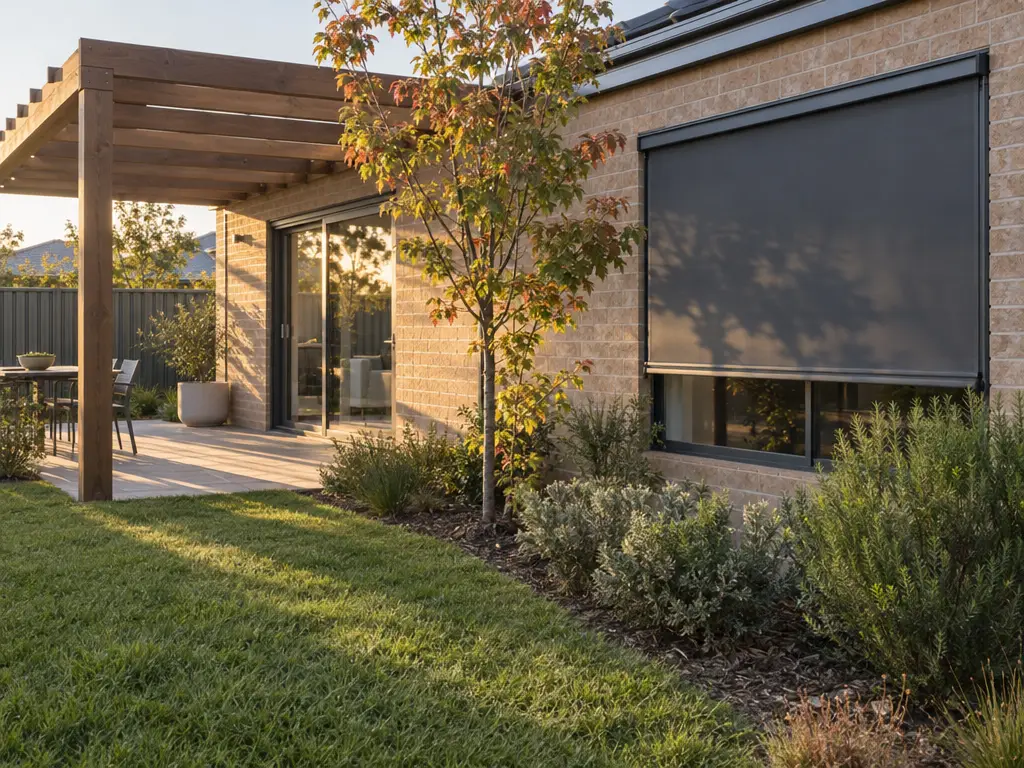
Shade outside the glass where you can. Shading the glass is the best way to cut unwanted heat gain. For warm and mild temperate climate zones, Your Home advises adjustable shade screens or deep overhangs to the east and west, and says screens that exclude low-angle sun work best. If an outside option suits your wall, our awnings page is a place to start.
Pair a pergola or veranda with plants. Because low sun slips under them, Your Home suggests combining them with planting.
Film is a real option with real catches. Some window films can halve a window's SHGC (its solar heat gain coefficient), which helps most on east and west glass. It may also reduce visible light, and it makes sun-exposed glass hotter, so industry guidelines apply to avoid thermal cracking and an accredited installer is advised. The ACT Government also warns that permanent reflective or tinting films may block valuable winter sun.
Inside coverings are the practical layer for existing windows. Up to 87% of a home's heat can be gained through windows. Louvres, blinds and curtains can improve a window's thermal performance and are especially useful to add to existing windows. See plantation shutters, blinds and curtains for what each looks like.
If you choose a corded blind or curtain, national safety standards require that no loop 220 mm or longer forms at or below 1,600 mm. The cleat must sit at least 1,600 mm up, the installer must attach a label with their details, and supplied warning labels must stay on.
A simple summer routine for west-facing rooms
Heat of the day: close curtains, blinds, windows and doors
As temperatures fall: open up
For west rooms, keep the glass shaded while the low sun is on it, then open once it's off the glass and the air cools.
The ACT Government's summer advice is to close curtains, blinds, windows and doors during the day and open them in the evening as temperatures fall. It's written for Canberra, but the logic travels.
West rooms need one adjustment. The sun is on west glass in the evening, so keep that glass shaded while the low sun is on it. Then open up once the sun is off the glass and the air has cooled. Anything adjustable makes this easier, because you can close down for the worst hour and open again without losing the whole evening's light.
West-facing windows at a glance
- West window, summer afternoon: angle of incidence near 0° to 30°Your Home, glazing
- Direct sun: about a single bar radiator per square metreYour Home, shading
- Effective shading: blocks up to 90% of that heatYour Home, shading
- Windows: up to 87% of a home's heat gainedYour Home, glazing
- Daylight saving ends 3am AEDT, Sunday 4 April 2027NSW Government
Five figures carry the whole story. A west window on a summer afternoon meets the sun at near 0° up to 30°. Direct sun delivers about a single bar radiator per square metre, and effective shading can block up to 90% of it. Windows account for up to 87% of a home's heat gain. And the evening timing shifts back when daylight saving ends at 3am AEDT on Sunday 4 April 2027.
What to check in your own home
Spend one evening this week noticing the sun rather than fighting it:
- Which rooms have west-facing windows or glass doors?
- Where do you sit between 6 and 7pm, and does the sun reach you or your screen?
- Is the window shaded from outside, or only from inside?
- Does an eave or pergola let low sun slip in underneath?
- Is your problem mostly heat, mostly glare, or both?
- If you have corded blinds or curtains, are the cleats at least 1,600 mm up, with no loop of 220 mm or longer below that?
Once you know which window you sit beside every evening and what it's doing to you, Lake Macquarie Shutters can talk through what suits that wall, inside and out. You can book a measure and quote on our contact page, or use the enquiry form below.
Sources
- https://www.nsw.gov.au/about-nsw/daylight-saving
- https://www.yourhome.gov.au/passive-design/shading
- https://www.yourhome.gov.au/passive-design/glazing
- https://www.climatechoices.act.gov.au/energy/energy-efficiency/window-glazing-or-treatments
- https://www.bom.gov.au/climate/ahead/outlooks/archive/20261008-outlook.shtml
- https://www.nsw.gov.au/legal-and-justice/consumer-rights-and-protection/safety/other-consumer-products/blind-and-curtain-safety