
Ordinary window glass lets most UVA through. Cancer Council Queensland puts UVA transmission at tempered 71.6%, smooth annealed 74.3%, against laminated 0% (completely blocked).
Turn those figures around and a plain pane stops only about a quarter of the UVA that reaches it. The working: 100 minus 71.6 is 28.4%, and 100 minus 74.3 is 25.7%. That "about a quarter" is our estimate, worked from those two figures.
For your skin, the news is mostly reassuring. Cancer Council says UV through untinted building windows "poses little health risk" unless someone spends extended periods close to windows in direct sun, or has a severe photosensitive skin disorder. The everyday cost is quieter: faded rugs, timber and photos.
How much UV gets through ordinary window glass?
- Deep eaves, verandas or awnings: less UV reaches the window
- Most UVB blocked
- Laminated: 0% of UVA passes
- Tempered: 71.6%
- Smooth annealed: 74.3%
- Closing curtains, blinds or shutters in strong sun can significantly reduce exposure
- Light damage is cumulative and irreversible
Glass does not block all UV: all commercial and automobile glass blocks most UVB, but how much UVA passes depends on the type of glass.
UVB is the part ordinary glass handles well. UVA is the part it lets through. Cancer Council's fact sheet says tempered and smooth annealed building glass can let around 70% of UVA through.
Where the window sits matters too. The same fact sheet notes that windows under deep eaves, verandas or awnings get less UV. A sliding door under a deep veranda sees less UV than a bare west window, even when both have the same glass.
Which window glass blocks UVA, and does thickness matter?
Share of UVA that passes through building glass
Glass type is the big lever. Laminated glass is a plastic interlayer between two sheets, and it stops UVA entirely. Tempered and plain annealed glass let roughly three quarters through.
ARPANSA, the national radiation agency, agrees: the UV protection of tempered and plain glass is "quite low for most" types. It also says double-glazed, laminated or tinted windows "may block greater than 98% of UVR (e.g. PF 50+)".
Thicker glass is not the answer. The effect of thickness on UV transmission "is limited compared with other factors".
You may already have laminated glass in a few spots. It is often used in injury-prone places such as bathrooms, doors and near floors, and meets AS 1288 safety-glass requirements. Toughened glass is a different matter: it has no thermal or acoustic benefit over other glass of the same tone and thickness.
If you are unsure what is in your frames, the original building or glazier's paperwork is the place to look.
Is UV through a window a health risk indoors?
UV through untinted building windows "poses little health risk", unless someone spends extended periods close to windows in direct sun or has a severe photosensitive skin disorder.
For most people, no. Cancer Council's fact sheet, published November 2017, says the need for tinting "should be weighed against the actual health risks". The exceptions are long stretches close to a window in direct sun, and severe photosensitive skin disorders.
Cancer Council's newer answer on sunscreen indoors says it is generally unnecessary. If you sit by a closed window in direct sun, clothing may be enough.
The step outside is where protection counts. When the UV Index is forecast at 3 or above and you are going outside to hang out washing or garden, use sun protection first. ARPANSA uses the same line: sun protection is advised when the UV Index is 3 and above. It also calls the best shade the inside of a building, where reflected and diffuse UV is completely blocked.
For the lake, the Bureau of Meteorology publishes a Newcastle UV forecast, with sun protection times in MetEye text views. Its advice is to use a combination of measures, never just one.
Why do floors, fabrics and photos still fade behind glass?
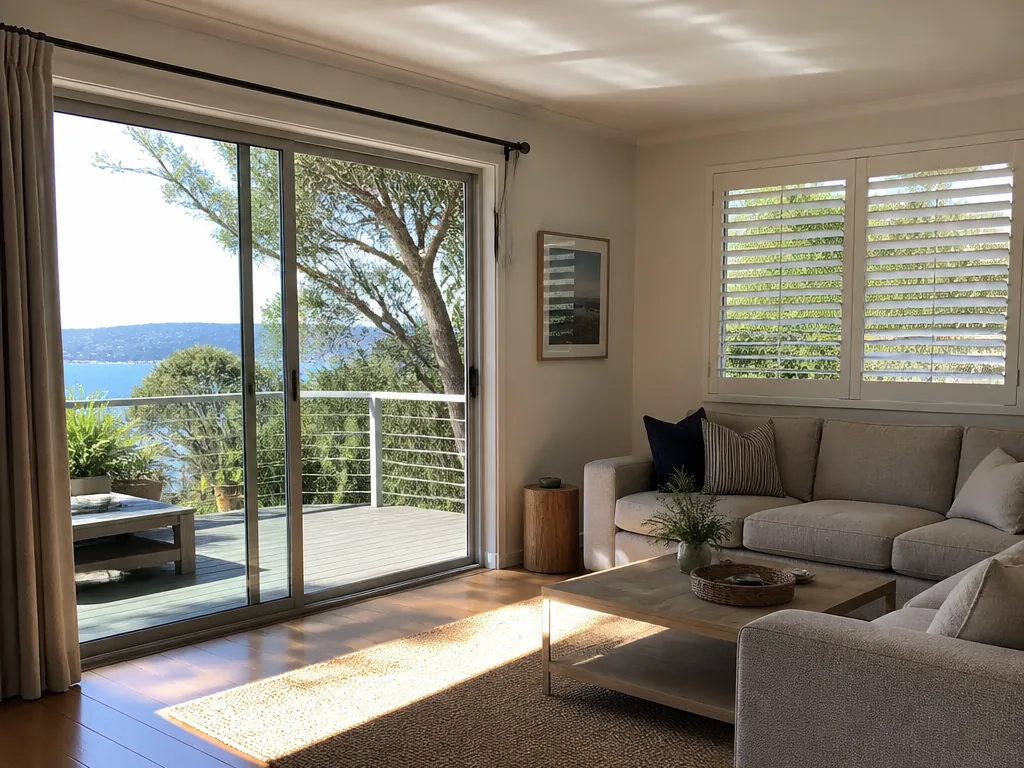
Because UV is only part of it. Conservators ICS say UV is particularly damaging, but visible light also causes fading, so removing UV "does not eliminate the risk of light damage". That damage is cumulative and irreversible.
This is why UV-blocking glass alone is not the whole fix. Your Home says appropriate glazing can reduce fading, but does not prevent it completely.
Some things suffer first. ICS names textiles, photographs, works on paper and watercolours as highly light-sensitive.
The sun also moves. ICS points out that a wall shaded in the morning can be sunlit later, and the patch shifts with the seasons as well. That cherished print may be safe at 9am and in full sun by 4pm.
What helps is cutting exposure at the right times. ICS says curtains, blinds and shutters can reduce the daylight reaching an artwork, and closing them in strong sun "can significantly reduce exposure". Where large windows or glass doors are the main source, UV-filtering film adds protection.
Window tinting for home glass, awnings or shutters: which fixes what?
| Option | What the sources say it helps with | What to watch |
|---|---|---|
| Laminated glass | Blocks UVA completely (0% passes) | A glazing change rather than an add-on, often used in bathrooms, doors and near floors, meets AS 1288 |
| Source: https://cancerqld.org.au/understanding-cancer/prevention/staying-safe-at-home/ https://www.yourhome.gov.au/passive-design/glazing | ||
| Double-glazed or tinted glass | "may block greater than 98% of UVR (e.g. PF 50+)" | Depends on the product |
| Source: https://www.arpansa.gov.au/understanding-radiation/radiation-sources/more-radiation-sources/sun-protection-shade | ||
| Window film on existing glass | Reduces heat, glare and UV, and some films can halve a window's solar heat gain coefficient | May reduce visible light, glass runs hotter in direct sun, follow industry guidelines to avoid thermal cracking, accredited installer generally best |
| Source: https://www.arpansa.gov.au/our-services/testing-and-calibration/ultraviolet-radiation-testing/film-glass-materials-testing https://www.yourhome.gov.au/passive-design/glazing | ||
| Deep eaves, verandas, awnings | Windows under them get less UV | Sun moves through the day and year, so shade shifts |
| Source: https://www.cancer.org.au/about-us/policy-and-advocacy/prevention/uv-radiation/related-resources/tinted-windows https://cancerqld.org.au/understanding-cancer/prevention/staying-safe-at-home/ | ||
| Shutters, blinds, curtains | Cut daylight reaching furnishings when closed in strong sun, improve thermal performance, especially useful on existing windows | They work when closed, so plan for the hours the sun hits |
| Source: https://www.icsconservation.com.au/tips-tricks/light-and-fade https://www.yourhome.gov.au/passive-design/glazing | ||
Each option aims at a slightly different target. Picking well starts with knowing which one you care about most: UV, heat, glare or fading.
Laminated or upgraded glass is the cleanest UV answer, but it means changing the glass. It is usually a renovation decision rather than a summer fix.
Window tinting for home glass works on the windows you already have. ARPANSA calls window films a popular way to reduce heat, glare and UV. Your Home says some films can halve the window's solar heat gain coefficient, which helps on east and west elevations.
There is a catch. Films may also reduce visible light, all day and all year. Also, glass with film exposed to direct sun runs hotter than untreated glass, so industry guidelines must be followed to avoid thermal cracking, and an accredited installer is generally best.
Outside shade stops sun before it reaches the glass. Cancer Council Queensland lists tinting windows and shading them with deep eaves, verandas or awnings as ways to cut indoor UV. If a window has no eave, an awning is the add-on version.
Shutters, blinds and curtains do something glass and film cannot. You choose when they cut the light. Your Home says window furnishings can improve a window's thermal performance and are "especially useful to add to existing windows". Energy.gov.au's advice for warmer months is to close coverings during the day to keep the home cool, and to open them when the sun is shining in cooler months.
That matters this summer. The Bureau's outlook issued 22 October has November to January daytime temperatures very likely above average across much of Australia, with eastern NSW inside the zone of high odds for unusually hot days.
Our view at Lake Macquarie Shutters is that the windows worth fussing over are the east and west ones, which get the long, low sun. Tilting louvre blades lets daylight bounce in off the ceiling while keeping direct sun off the floor and sofa. You get light without parking furniture in the beam. Blade width changes how that looks, which our louvre blade widths guide covers. For the afternoon side of the house, see west window glare and why the daylight-saving sun is so hard to block. For the heat side, see do plantation shutters block out heat?
Many homes end up with a mix: shade outside on the worst window, and coverings inside that close during the hours the sun lands. If privacy is also on the list, our guide to privacy without losing light picks up there.
Laminated glass blocks all UVA, while tempered and annealed pass over 70%
- Laminated building glass: 0% of UVA passes (blocked completely)Cancer Council Qld
- Tempered glass: 71.6% of UVA passesCancer Council Qld
- Smooth annealed glass: 74.3% of UVA passesCancer Council Qld
- Double-glazed, laminated or tinted windows: may block greater than 98% of UVR (e.g. PF 50+)ARPANSA
- Sun protection advised: UV Index 3 and aboveARPANSA
Removing UV exposure therefore does not eliminate the risk of light damage ICS
Glass type sets how much UVA gets in. Thickness barely moves it. The UV Index tells you when to cover up outside. Coverings and shade decide how much light reaches the things you want to keep looking new.
Your next step: start with the windows that get the long sun
Walk the house on a sunny afternoon and note which windows throw direct sun onto floors, rugs, timber or photos, and when. Check the Newcastle UV forecast before you head outside. Then match the fix to the target: glass or film if UV is the worry, outside shade or closable coverings if fading and heat at certain hours are the problem.
If shutters, blinds or curtains are part of your answer, book a measure and quote with Lake Macquarie Shutters. We will look at the windows that catch the sun and talk through what suits each one.
Sources
- https://www.cancer.org.au/about-us/policy-and-advocacy/prevention/uv-radiation/related-resources/tinted-windows
- https://cancerqld.org.au/understanding-cancer/prevention/staying-safe-at-home/
- https://www.cancer.org.au/iheard/should-i-wear-sunscreen-when-indoors
- https://www.arpansa.gov.au/understanding-radiation/radiation-sources/more-radiation-sources/sun-protection-shade
- https://www.arpansa.gov.au/our-services/testing-and-calibration/ultraviolet-radiation-testing/film-glass-materials-testing
- https://www.icsconservation.com.au/tips-tricks/light-and-fade
- https://www.yourhome.gov.au/passive-design/glazing
- https://www.energy.gov.au/households/windows
- https://www.bom.gov.au/nsw/uv/newcastle.shtml
- https://www.bom.gov.au/climate/ahead/outlooks/